An economics game for iPhone and iPad

Find the bottleneck. Set the price. Build the company.

You start with one bottling line on a floating island. Fix the slow machine, pick a price, hire a CFO, take the company public. Somewhere along the way you figure out why the fourth worker adds less than the first, and what a P/E ratio is for.

11 businesses87 concepts, each with a quizSolo, with friends or in class
Bean Street Coffee · floor 1

A line can only run as fast as its slowest machine. Add a machine and watch the bottleneck move.

37.5 bags/min
The roaster is the bottleneck. Adding a grinder would do nothing.
SCALE 1:1 · DWG M-01
Who it's for

Play it alone, with friends or with a class

It's the same game every way. What changes is who else is on the scoreboard.

On your own

A tycoon game with a point

Nine chapters of goals, each with a deadline and up to three stars. Short challenges like Unblock the Line, Price War and Patent Cliff drop you into one problem at a time. Every run you finish goes on your scoreboard.

Goal ladderChallengesDifficulty levels
With friends

Beat your friends at capitalism

Make a group and share the code. Everyone's companies show up on the same street and the same scoreboard, and you can make an offer on a friend's business. Quiz scores stay private.

Shared townScoreboardBuy a friend's business
In class

Something to assign besides a worksheet

Make a class and put the QR code on the board. Students join as guests with no email needed, and you can follow each one's concepts, quizzes and score.

Class codesProgress trackingNo student sign-up
How it plays

It starts with one bottling line

It can end with a public company that owns a rocket maker. New ideas show up in roughly the order an intro econ course covers them: production first, then markets, then finance.

On the floor

Build a factory

Lay belts, place machines and hire staff on a floating island. Spot the slow station, fix it, and see why the fifth worker adds less than the first.

BottlenecksMarginal productDiminishing returnsFixed vs. variable cost

A film studio floor on day 833: five production lanes feeding one shipping dock, earning $7.62M a day
In the market

Price what you make

Every business sells into a different kind of market. Take the going price as a solar maker, fight a price war as a chip foundry, or face a regulator as the power company.

MR = MCElasticityOligopolyMonopoly
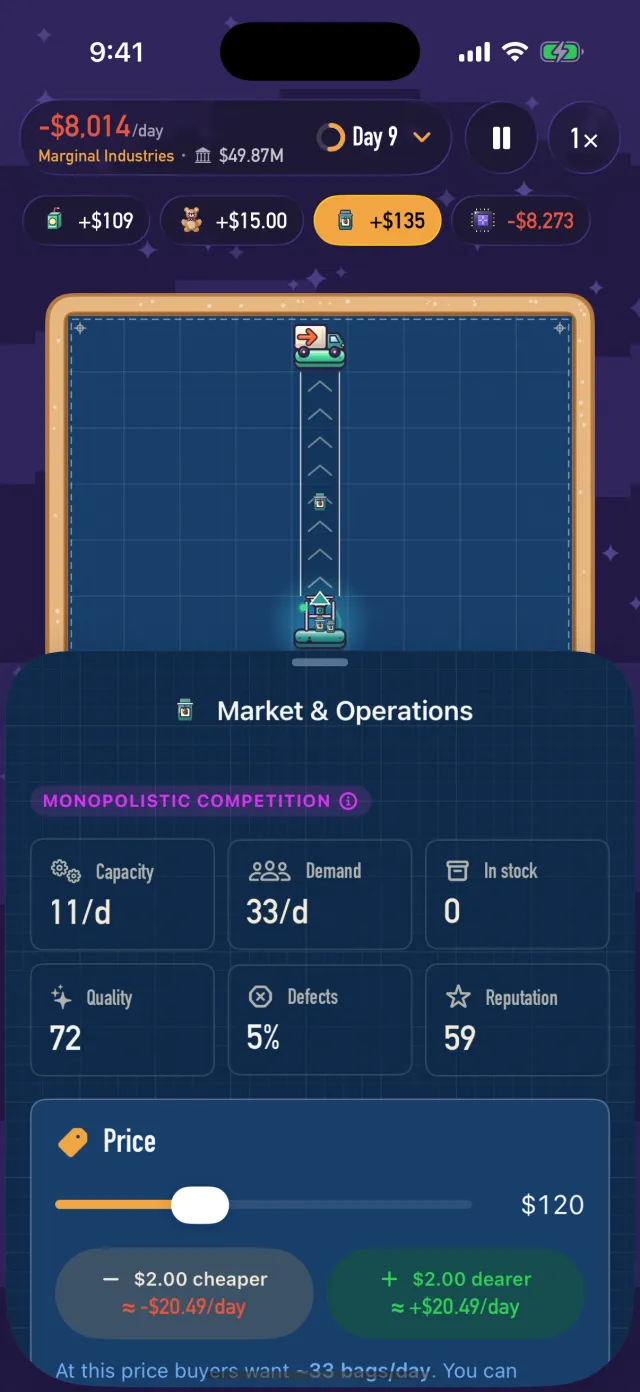
The Market and Operations panel: capacity, demand, quality and a price slider for coffee
On Wall Street

Grow the company

Go public, report quarterly earnings, hire a CFO, buy out rivals, invest your cash and sell a business through a broker. Meanwhile interest rates and inflation move under you, and the board wants answers every quarter.

IPOP/E ratioAcquisitionsBusiness cycle
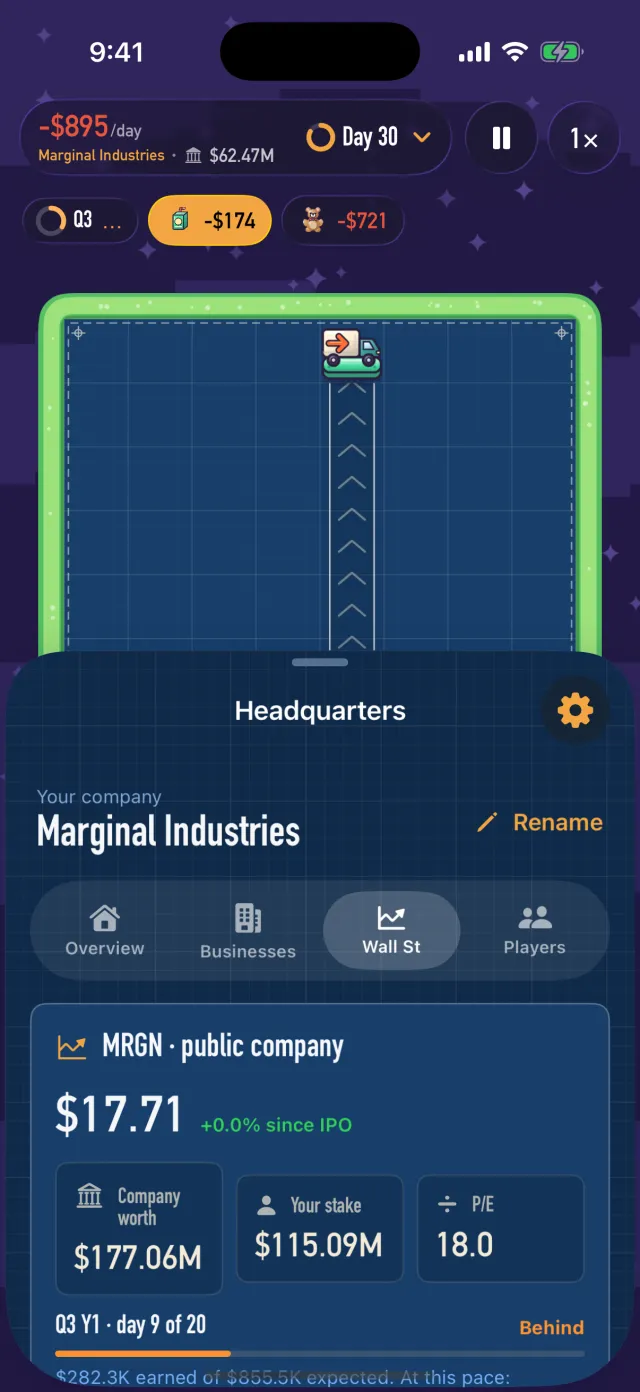
Headquarters after the IPO: share price, company worth, the player's stake and the P/E ratio
The lesson loop

No lecture first

  1. You hit the problemProfit stalls even though you added a machine.
  2. A concept card explains itA few sentences about what just happened on your floor.
  3. A quick quiz checks itOne question, right then, while it still makes sense.
  4. A reading link goes deeperEach one links to a longer article if you want more.
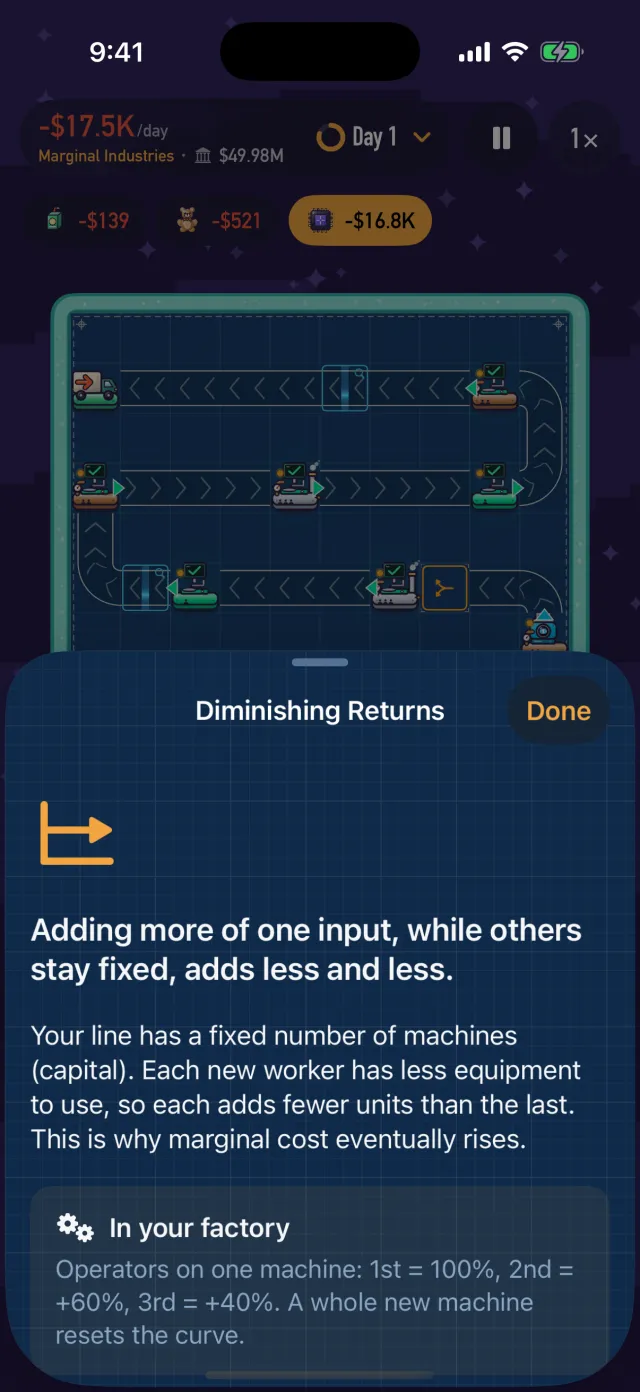
The Diminishing Returns concept card, with a note about what it means for the player's own factory
A concept card, as it appears in the game
Try it

Where should you price a bag of coffee?

Raise the price and you sell fewer bags. Lower it and you sell more, but each one earns less. Drag the price and find where profit peaks. In the game you make this call every day, for every business.

Bags / day120
Revenue$960
Profit$480

Each bag costs $4 to make. In the game, the market type changes the shape of this curve: a monopoly gets a steep one, and a perfectly competitive seller gets a flat line: one price, take it or leave it.

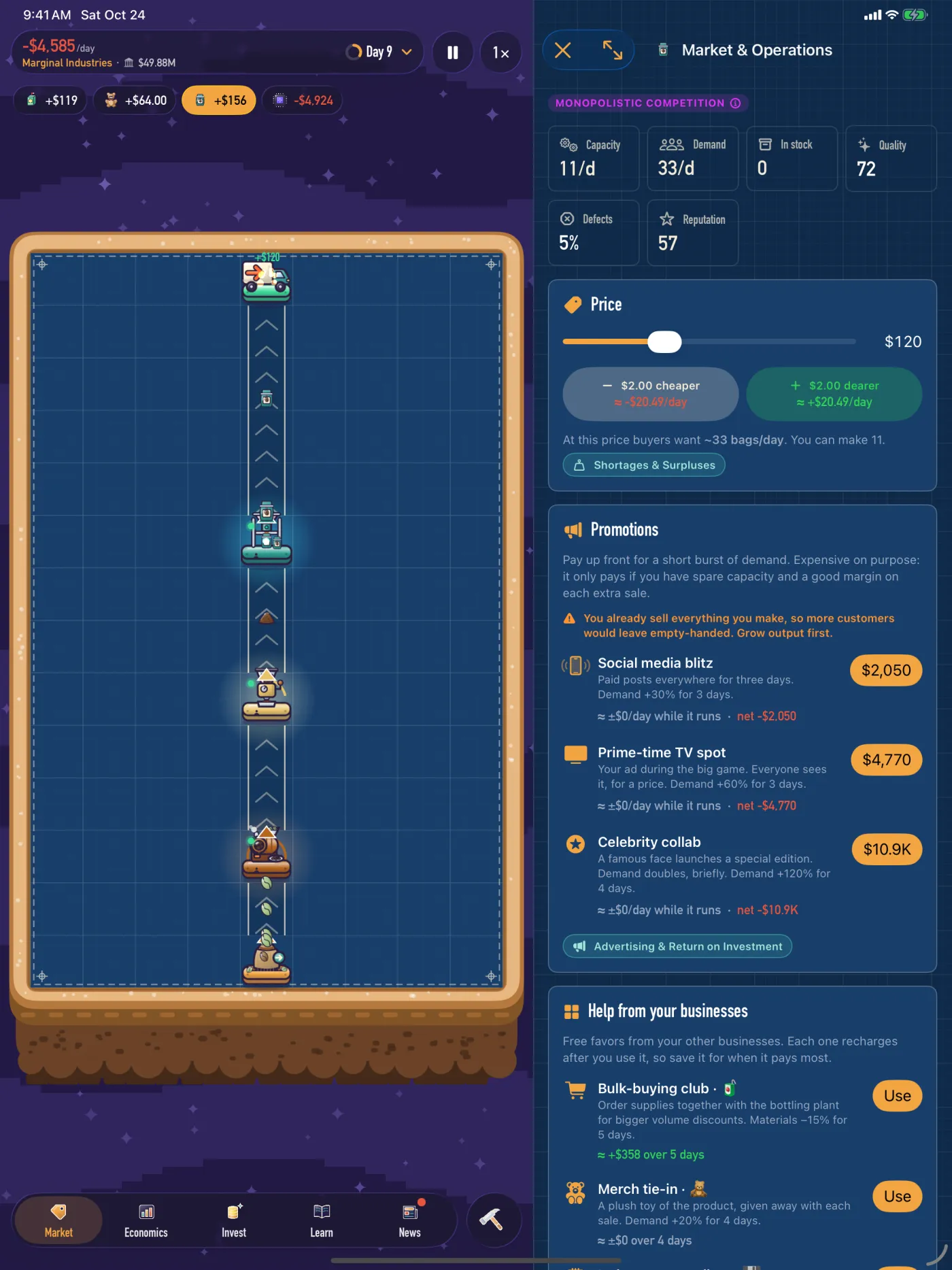
Marginal on iPad: the coffee floor on the left, the pricing and promotions panel on the right
On iPad, the market panel sits next to the floor
The businesses

Eleven businesses, seven kinds of market

Citrus Bottling Co.Perfect competition
Teddy Toy WorksMonopolistic competition
Bean Street CoffeeMonopolistic competition
Spotlight StudiosPlatform · network effects
Silicon FoundryOligopoly
Sunforge SolarPerfect competition
MediCure LabsMonopoly · patents
Volt Power Co.Regulated natural monopoly
Northstar AppsSubscriptions · churn
Charge MotorsOligopoly
Apex OrbitalOligopoly
Your companyAll of them, on the stock market
For teachers

Using it in class

Marginal gets tested with high school and college students. It fits next to an intro micro or macro unit, a business elective, or a personal finance class.

  • Classroom mode. Make a class, share a code, and see each student's progress: day, cash, businesses, concepts learned and quiz results.
  • No sign-up for students. They start as guests, so there are no accounts or email addresses to collect.
  • Board meetings. Every quarter the board asks three questions about what happened at the student's company that quarter, and good answers pay off.
  • A shared town. The whole class appears on one street and one scoreboard, and students can trade businesses with each other.
  • A built-in glossary. Every term in the game is one tap away.
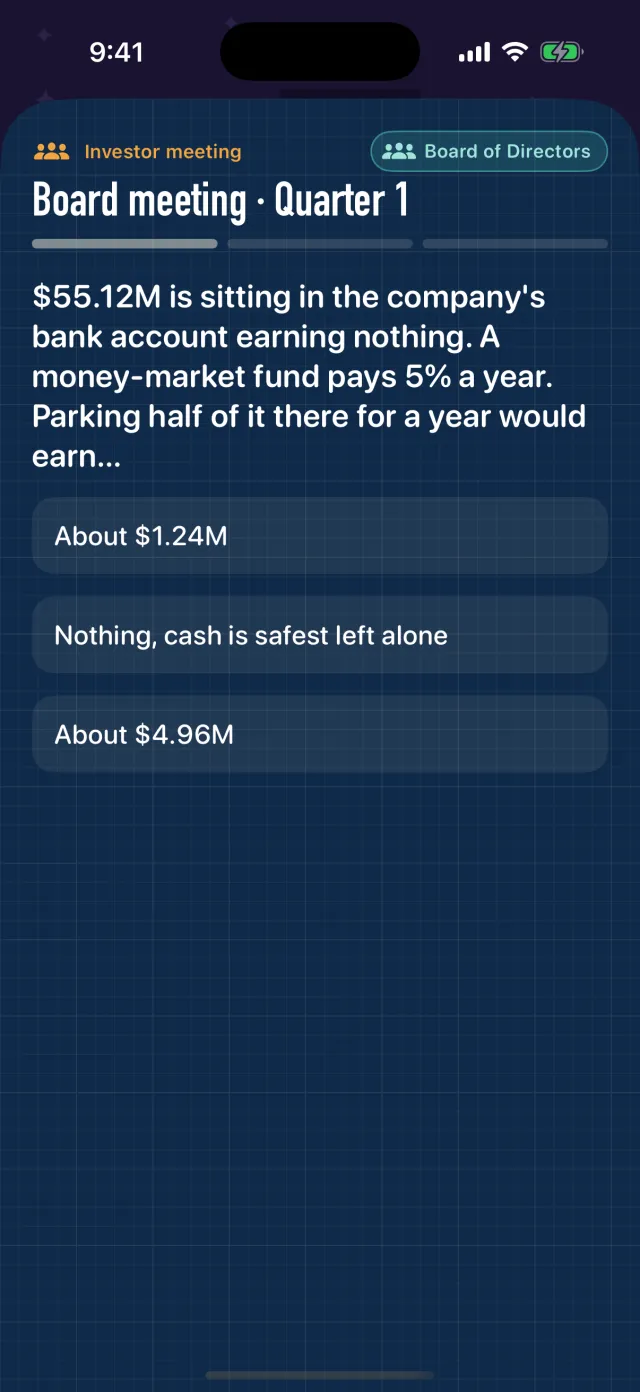
A board meeting question about how much $55M in idle cash would earn in a money-market fund
A board meeting question
What students learn

Production

Bottlenecks, capacity and utilization, marginal product, diminishing returns, division of labor, the learning curve, economies of scale and scope, buffers, preventive maintenance.

Costs

Fixed vs. variable cost, marginal cost, sunk cost, opportunity cost, the cost of quality, inventory holding cost.

Markets

Perfect competition, monopolistic competition, oligopoly, price wars, monopoly, deadweight loss, regulation, elasticity, MR = MC, shortages and surpluses.

Macro

The business cycle, inflation, interest rates and monetary policy, fiscal policy, unemployment, exchange rates, income elasticity.

Finance

Income statements, IPOs, earnings and EPS, P/E ratios, dividends, buybacks, valuation, acquisitions, antitrust, capital gains tax, diversification.

Running a company

The principal-agent problem, boards of directors, what a COO, CFO, CMO, CTO and CPO do, subscriptions and churn, freemium, network effects.

Now in beta on TestFlight

Start your company

Free while it's in beta, on iPhone and iPad with iOS 17 or later. Shake your phone in the game to send feedback. Every report gets read.

Join the beta
APPROVED · M. ECON